 Oly Bock
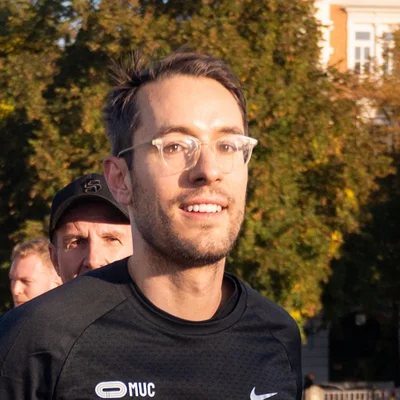
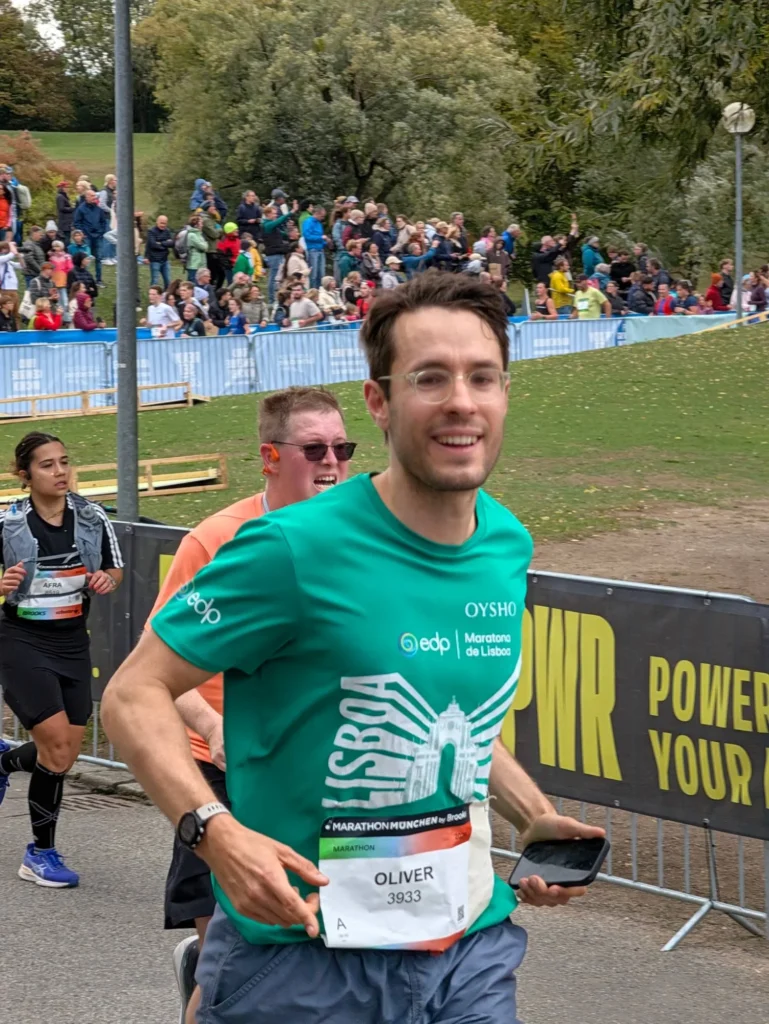
Sunday, 11 October, 9:22 in the morning, close to the Olympiapark. My second marathon, one year after Lisbon. I crossed the line in Munich after 4:03:51, six minutes slower than my first one. And still it was the strongest marathon I have run so far.
Short version: I ran the first 6 kilometres exactly to plan, then raced. Around km 30 a new goal appeared, at km 40 it disappeared, and so did my energy. The surprising part: when I hit the wall, my heart rate was low.
The Plan Lasted Six Kilometres
The plan was simple: keep my heart rate below 145, the upper end of my easy zone, and let the race come to me. For six kilometres I did exactly that. 5:45 to 6:05 per kilometre, heart rate 144 to 147. Calm, controlled, boring in the best way.
Then kilometre 7: 5:13, heart rate 155. It felt good, and with a cold wind, running slower simply made me cold. From there the cap was gone and never came back. Kilometres 11 to 26 were the fast block, mostly between 5:00 and 5:30, heart rate slowly climbing from 148 to 162.
Numbers I decide on before the start don’t survive the starting gun. That is the first honest lesson of this race.
Kilometre 30: A New Goal Appears
Around km 30 I did the maths and realised that finishing under four hours was suddenly possible. It instantly became the goal. At km 34 and 35 I pushed: 5:15 and 5:03, partly downhill, heart rate 162 and 165. That was my under-four attempt.
Kilometre 40: The Wall Was in My Legs
At km 39 I felt sick, at a heart rate of 155, much lower than in Lisbon. Then the maths turned against me: under four hours was gone. And with it, my energy. Kilometre 40 took 6:26, then 7:19, then 7:35. It felt like five times the work for the same pace.
Here is the most interesting part of the data: during those slow kilometres my heart rate dropped to 147 and then 139. If my heart and lungs had been the limit, it would have stayed high. It didn’t. What gave out were my legs, my glycogen stores, and, honestly, my motivation once the goal was gone.
The Last 800 Metres
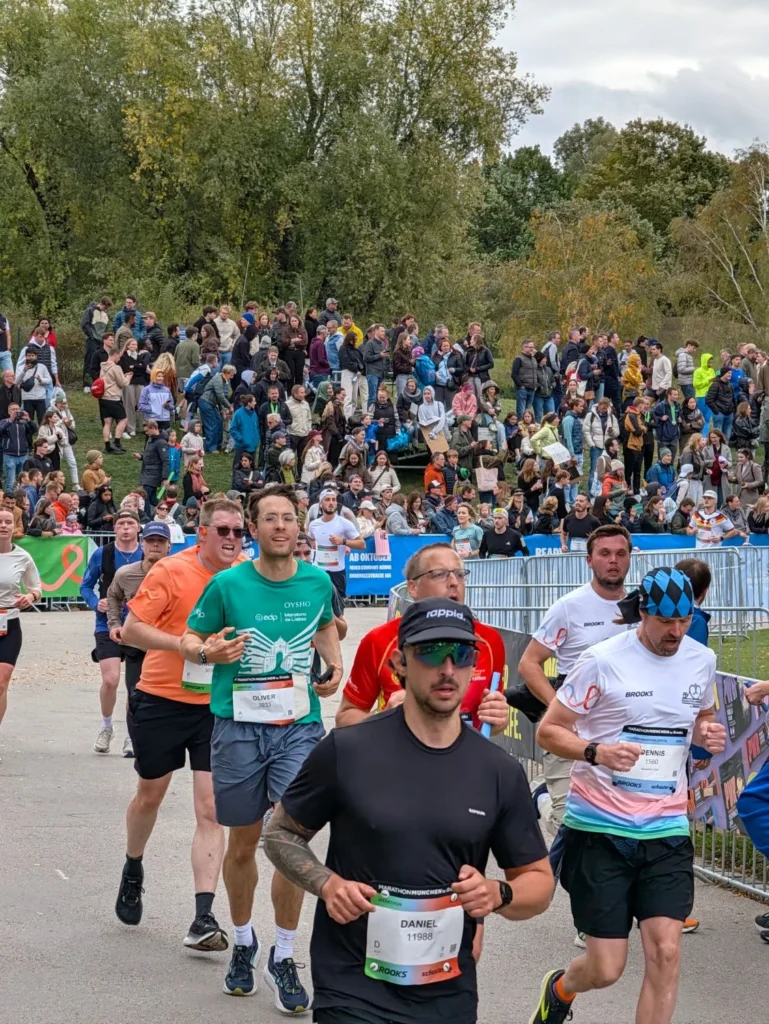
I walked. And then I started running again, 5:40 per kilometre for the last 800 metres, all the way to the finish. That sounds small, but a year ago my belief was: once you walk, you are out. Munich proved that wrong, and it is the moment I am proudest of.
Lisbon vs. Munich
| Lisbon 2025 | Munich 2026 | |
|---|---|---|
| Finish time | 3:57 | 4:03:51 |
| Average heart rate | 166 | 154 |
| Temperature | 20 °C | 9 °C |
| Dew point | about 18 | about 7 |
| Longest run before | 28 km | 22 km |
Twelve beats lower on average, for almost the same pace. The cool, dry weather did most of that work. At a low dew point sweat evaporates freely, the body needs less blood in the skin to cool down, and the heart can stay lower at the same speed. In Lisbon’s warm, humid air the same decision cost a lot more.
What Worked
- Fuelling: salt pretzel sticks and kefir before the race, which kept my stomach happy, then a banana, and one gel with water just before the start. During the run four of my own gels, always taken with water, plus the electrolyte drink wherever a station had one, because more sugar. Om nom nom. While running it is gels only: a protein bar once wrecked my stomach in a half marathon. No stomach trouble until late in the race.
- Known shoes: the same pair I trained in. No experiments on race day.
- Park paths: the softer trail sections felt noticeably easier on my legs, without running any faster.
- Running form held: my cadence stayed stable over all 42 kilometres and only dropped in the walking sections.
What I’ll Change
- More carbs per hour: four gels in four hours is about 25 to 35 grams per hour, far below the 60 to 90 grams most runners aim for. I will practise more in long training runs over the winter, so race day only repeats what my stomach already knows.
- Longer long runs: my longest run before Munich was 22 km. Going from 22 to 42.8 km is a big jump, and the last kilometres showed it.
- A goal that can’t disappear: a time goal that appears at km 30 can also vanish at km 40. Next time I want a goal that still means something when the clock says no.
My Takeaway
- The wall can come from your legs, your fuel or your head. Mine was legs, fuel and a goal that evaporated.
- Weather can make you look more disciplined than you were.
- After a walk break the race goes on. Starting to run again is a skill.
Closing Thought
After the race my first thought was: “If I sign up for a race, I race it. Otherwise I give the ticket away.” I like the first half of that sentence. The second half I am not so sure about anymore. Racing went well at 9 °C. It didn’t in Lisbon. Maybe the real lesson is to decide which races to run, and then to keep the right to choose on race day.
If you are training for your next marathon too: why slow running can feel harder than fast and why I am learning to run slower are the two posts that led up to this one.